

 Français
Nowadays, people tend to be more aware of alternatives in textile production, as it is a highly polluting industry. Indeed, clothing consumption produces a huge amount of CO₂ and uses water excessively. To be more sustainable, we can opt for natural and organic textiles, recycled fibers, or second-hand clothing.
Most designers or textile producers who opt for natural dyes are actually returning to ancient methods of sustainable natural dyeing.
WHAT IS A NATURAL DYE?
Natural dyes are derived from plants (roots, stems, leaves, flowers), insects, minerals, or organic sources. Before the advent of synthetic dyes in the mid-19th century, natural dyes were ubiquitous throughout the world. The first synthetic dye, mauve, was discovered accidentally by English chemist William Henry Perkin in 1856 while he was trying to make quinine. In fact, we have evidence of its existence in ancient civilizations (India and China, for example).
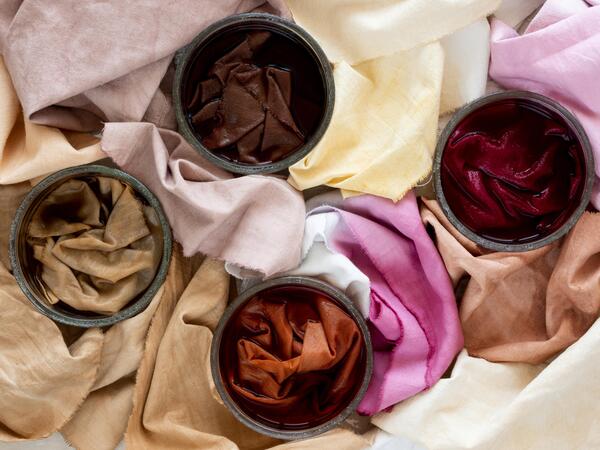
A dye is a colored substance that has an affinity for the substrate to which it is applied. Some plants can have more than one color depending on the part of the plant used for extraction. Dyes must be applied to textiles using a mordant to improve the fastness of the dye to the fiber, except for a few specific plants, such as indigo and tannin plants, for example.
THE DIFFERENCES BETWEEN NATURAL AND SYNTHETIC DYES
Synthetic dyes are derived directly from petroleum, and their production requires a lot of energy. The vast majority of dyes are synthetic, and let’s be honest, it is not feasible to eliminate them from the industry. Over the past 30 years, the production of synthetic dyes has declined in the United States, Western Europe, and Japan but has increased in Asian countries, particularly China, India, and South Korea. This is because they allow colors to be used in many industries, significantly reducing production costs and time.
However, the use of synthetic dyes can cause many health problems, such as respiratory diseases and skin irritations, and the list is very long, as is the list of chemicals used in this industry. Today, many harsh chemicals have been banned in the textile industry, but in ten years, many other products currently in use could also be banned.
These synthetic dyes also have a significant impact on the environment. Today, the clothing industry consumes tons of water and thousands of different chemicals, some of which are highly toxic. In many countries, dirty water is still discharged into the environment. According to DNB asset management, more than 20% of water pollution worldwide is caused by the textile industry.
WHY CHOOSE NATURAL DYES?
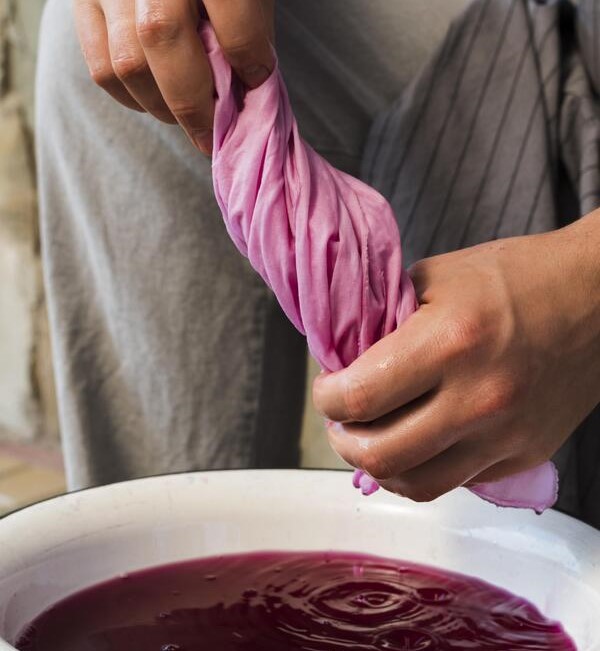
On the contrary, natural dyes respect and follow the rules of nature. They are biodegradable and very safe for our skin and the environment. Most natural dyes are safe for the skin, and many of them even have antimicrobial, antifungal, anti-inflammatory, antioxidant, and hypoallergenic properties. In fact, most of the plants used are also medicinal plants.
People with allergies are more interested in clothing made with natural dyes because of the toxic components in synthetic clothing. This means taking even more care of your fabrics and clothing. For example, naturally dyed clothing lasts longer if washed with an eco-friendly detergent. In addition, natural dyeing is not compatible with all types of clothing. With these eco-friendly dyes, you will feel safe and have no health problems.
We are on the cusp of an era where we could lose all the skilled people capable of producing natural dyes in this world if we do not encourage production. Of course, the production of natural colors poses many problems, such as production time, higher costs, color alteration, the complexity of the dyeing process, and color variations that must be accepted. We fully agree that synthetic dyes will never be replaced, but we dream of a world where all the different alternatives mentioned above could play an important role in the future of the textile industry.
Conclusion
We hope that all of these points have raised your awareness. We strongly encourage alternatives to protect the environment, and the use of natural dyes is one such solution.
At Fibre Bio, we offer a wide variety of natural fabrics and products ready for dyeing. We supply the raw materials that allow any natural dyer to express their art. We can also help you develop your natural dye collections. We are convinced that natural dyes can be a solid alternative to protect the environment and ourselves. What about you? Contact us at [email protected] if you would like more information!